
Research Associate of the Department of History and Anthropology has Co-Edited a Major Documentary Collection
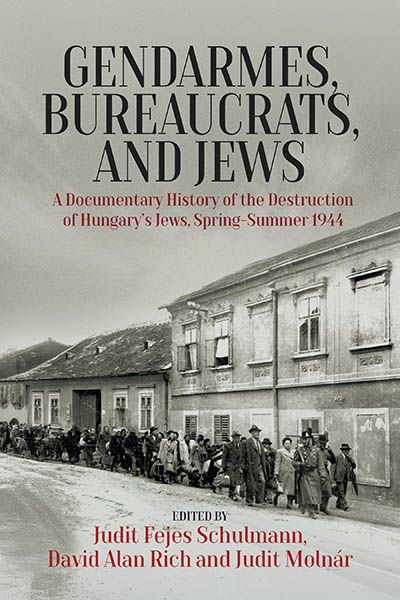
Dr. David Rich, a Research Associate of Catholic University’s Department of History and Anthropology, is the co-editor of a new documentary history of a chapter in Hungary’s participation in the Holocaust: Judit Fejes Schulmann, David Alan Rich, and Judit Molnár, ed., Gendarmes, Bureaucrats, and Jews: A Documentary History of the Destruction of Hungary’s Jews, Spring-Summer 1944 (Berghahn, 2025).
The book is a collection of primary sources documenting the swift and devastating deportation of Hungary’s Jewish population (over 440,000 between May and July 1944) to Auschwitz. The book argues that the Hungarian state’s active participation was crucial to the speed and scale of the Nazi genocide in Hungary. It counters the notion that the Holocaust in Hungary was solely a German operation by presenting essential, unabridged primary sources in English for the first time. These documents, including reports from Hungarian officials, offer insight into the genocidal program’s implementation. Of particular note are previously unpublished reports, including progress reports from Gendarmerie Lieutenant Colonel László Ferenczy, the Hungarian liaison to Adolf Eichmann, which detail the Gendarmerie’s role in the deportation process.
Dr. Rich explains “The surprise for me was how swiftly and completely a Royal Hungarian Gendarmerie lieutenant colonel named Ferenczy managed the uprooting, concentration, expropriation, and deportation of almost a half million people in 1944, utilizing militarized police forces – the gendarmerie. They swept greater Hungary (excepting Budapest) of its Jewish population in about ten weeks. Over a decade ago, Judit Schulmann, a fellow historian working on Nazi era cases with me at the Office of Special Investigations in the U.S. Department of Justice, told me about these documents and we made a plan (over beers) to produce the first critical edition in translation of all Hungarian materials that describe the Hungarian role in seeing this project through. As I read Ferenczy’s reports, as well as two sets of reports on the operation’s progress in provincial centers, I wondered how these had never been put before the army of Holocaust researchers who don’t command the Hungarian language, but also realized how wonderful the complete set could be as a pedagogical tool for exploring mass state violence against peaceful minorities.”
Dr. Árpád von Klimó, Ordinary Professor of History, a specialist in 20th-century central European history, and Chair of the Department, comments “Finally, Holocaust researchers can make use of previously unpublished, translated Hungarian documents and an excellent introduction which will help us better understand the ‘Holocaust after the Holocaust’ of 1944.”