
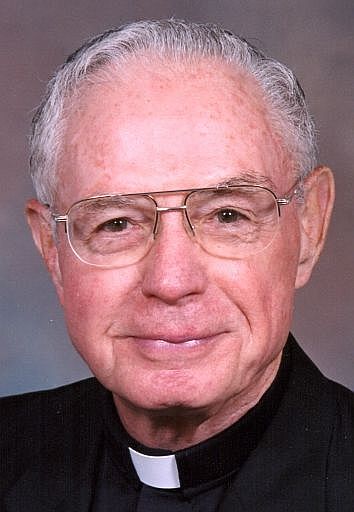
(photo courtesy of Paulist Fathers)
The Department of History and Anthropology mourns the recent passing of our deeply valued colleague and cherished friend, Fr. John E. Lynch, who died on 15 November 2025 at the age of 101.
Jack Lynch was born in New York City, but his family relocated to Washington when he was seven years old and he grew up in D.C., attending St. John’s College High School. He entered priestly formation with the Paulist Fathers in 1942 and was ordained on 1 May 1951. After several years on parish assignment in Los Angeles he undertook graduate degrees at the Pontifical Institute of Medieval Studies at the University of Toronto, gaining his Ph.D. in 1959. That same year he began teaching at St. Paul’s College, the Paulists’ house of formation down the street from Catholic University, and in 1967 joined the university’s faculty, eventually becoming Ordinary Professor of History and Canon Law. He served as Chair of Canon Law (1974-1983) and of History (1983-1986). He later served as Academic Vice President for Graduate Studies (1991-1998) before his retirement from the faculty in 1999. After that he spent nearly a decade as the Paulists’ archivist, based at St. Paul’s College.
Fr. Lynch was a historian of medieval canon law. Among his publications are The Theory of Knowledge of Vital Du Four (Franciscan Institute, 1972), many articles in scholarly journals including The Jurist and The Catholic Historical Review, and chapters in The Code of Canon Law: A Text and Commentary (Paulist Press, 1985) and New Commentary on the Code of Canon Law (Paulist Press, 2000). He served on the board, and was later vice-president, of the Canon Law Society of America and on the executive council of the American Catholic Historical Association. He directed 18 doctoral dissertations and dozens of licentiate and master’s theses. He also received the Benemerenti (1995) and the Pro Ecclesia et Pontifice (1999) medals in recognition of his service to the Catholic Church.
For those who knew and worked with him during his long career at the university, what remains most in memory is his warmth and kindness.
W. John Shepherd, University Archivist and Head of Special Collections, recalls Fr. Lynch fondly: “No matter his duties as an academic administrator, faculty, or archivist (with the Paulists), he never forgot he was a priest, one who took personal interest in those around him, especially as a kind and spiritual comforter to those grieving for loved ones.”
Dr. Nelson H. Minnich, Ordinary Professor of History and Church History, remembers Fr. Lynch as “a very kind and helpful person. Students were grateful for the valuable handouts he gave them, such as that which explained how to make proper canon law citations, and for his willingness to direct difficult dissertations. He was warm and welcoming to all, able to bring people together, a calming influence in contentious situations, balanced and fair in his judgments, prudent and wise in his decisions, patient and gentle in his dealings, a much-valued and beloved colleague.”
Dr. Robin Rohrer (Ph.D. 1985), Professor of History at Seton Hill University, shares this reminiscence: “Although Medieval Studies was not my major field, I am very grateful to have had Fr. Lynch’s kindness and encouragement during my time as a PhD student from 1982 to 1985. I was a new Ph.D. student in Spring 1982 and I took his Medieval Studies II seminar. He quietly encouraged my work in the class, especially to participate in discussion and provide my point of view. He gave me confidence at a time when I most needed it, and I have used his approach to instill confidence in my students over the years. As a teaching assistant and during the summer of 1983 we shared many conversations while I prepared to take my major comps. Many of my students have heard my ‘Father Lynch’ story and how he made such a difference in my time at Catholic and my academic career. May he rest in peace.”